
Circle of Transmission: The Living Loom
Cultivating the Spirit: A Conversation on the Living Transmission of Via-Hygeia
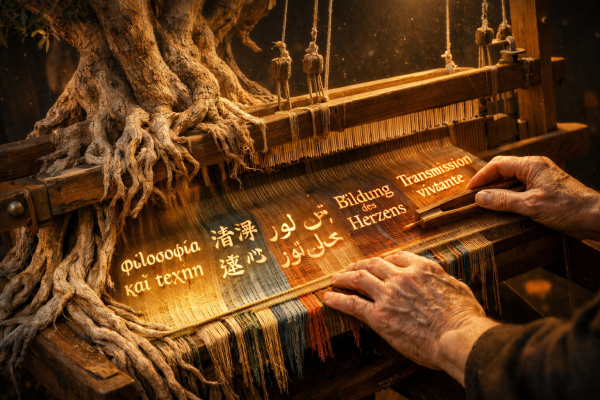
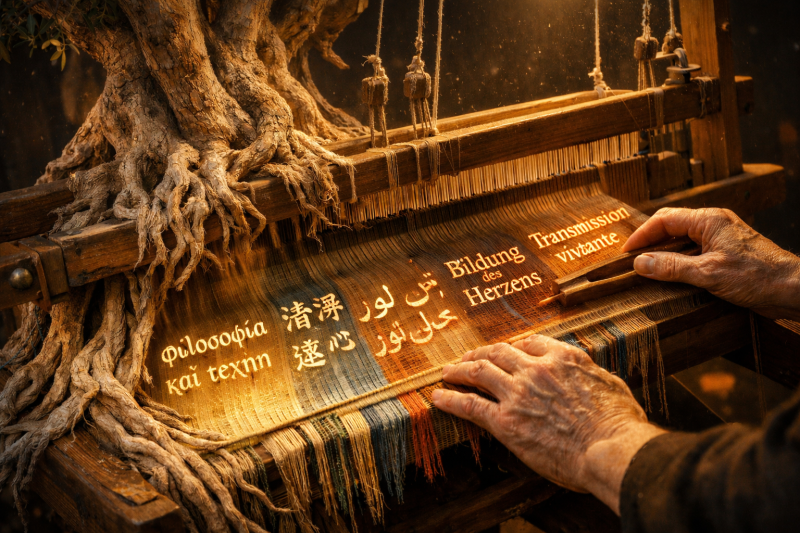
Legend of the Illustration: A venerable olive tree, its roots marked by time, descends to transfigure into the living threads of a loom. Under patient hands, ancient wisdom becomes a luminous tapestry: the Greek philosophía kai téchnē (φιλοσοφία καὶ τέχνη), uniting contemplation and craft; the Chinese qīngjìng lián xīn (清净莲心), evoking the purity of the lotus heart; the Arabic nūr ʿalā nūr (نور على نور), layering light upon light; the German Bildung des Herzens, calling for the inner formation of the heart; and the French Transmission vivante, affirming our duty of living transmission. Bathed in a warm, contemplative glow, this quiet labor transforms scattered heritage into a continuous whole—ensuring that knowledge is not owned, but faithfully received and entrusted to the future of the human spirit.
*
This is not the opening of an institution. It is the beginning of a conversation—one that carries a particular quality in the old Turkish word sohbet, the gathering where hearts are polished through companionship, and in muhabbet, the loving speech that fills the form with warmth.
For years, we were known as Via-HYGEIA Bibliotherapy. The name described a method—matching the right text to the right moment—and it served us well. But a method is not a home. As we stand at this crossroad, we recognize that what we have cultivated together is not a therapeutic service, but a living circle. And so we are opening a new chapter: not a rebranding, but a naming of what was already alive. We are becoming Via-HYGEIA Circle of Transmission.
A circle has no head and no foot; it has only a center, which is the text itself, and a warmth, which is the conversation. But conversation here has three layers:
- The Conversation: The open door in English that welcomes the stranger.
- Sohbet: The old Turkish discipline of companionship, the form of gathering where hearts are polished through presence and patience.
- Muhabbet: The affection that fills the form, the heart-substance, the loving speech that makes the circle a home rather than a meeting.
We gather in sohbet, and we speak in muhabbet.
We are small. We are temporary. We operate on volunteer labor, private resources, and the love of essences. We do not claim to be the sole guardians of these texts, nor do we warn of extinction. These manuscripts have survived empires; they will survive us. Our task is simply to keep the thread taught in our generation, to pass it cleanly, and to welcome those who recognize it.
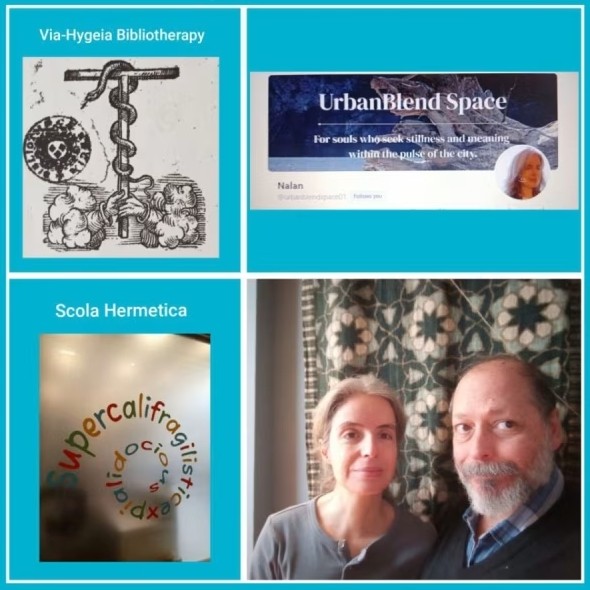
My wife Nalan and I share this life of cultivation in Türkiye. She animates Urban Blend, offering trainings, coaching, and creative drama for those seeking stillness within the pulse of the city. Together, we animate the Scola Hermetica, where the hermetic tradition is practiced as a living orientation rather than studied as a museum piece. Bibliotherapy—now Circle of Transmission—remains my particular work: the art of matching the right text to the right moment. But what unites all of this is not therapy; it is cultivation: the patient tending of a garden where living transmissions take root.
A book on a shelf is a sleeping thing. A text in conversation is awake. Living transmission means that the wisdom of Ibn Masarra, the inner craft of the Xiuzhen Baochuan, and the theosophy of Jacob Boehme are not preserved behind glass. They pass from hand to hand like a cup of tea in a circle of friends, with the understanding that the drinker will taste something the host cannot taste for them.
We began with the Greeks and Romans not to claim a foundation, but to learn the grammar of attention. We moved into Christianity, Islam, and the Eastern philosophies not to conquer territory, but because we recognized the same fragrance in different vessels. The seeker who reads Aristotle on dreams and then turns to Suhrawardi is not studying history; they are entering a conversation that has been ongoing for millennia about how the human being stands before the Real.
The loom is the true image of our work. We cultivate the Classical roots—Aristotle, Plutarch, and the Hellenistic treatises on dreams and prophecy—not because they are superior, but because they are the grammar without which the later voices become noise. We tend the Eastern field, where our annotated reading of the Xiuzhen Baochuan restores the rigor of a Daoist manual too often reduced to wellness trends.
We hold the bridge of Islam and Russia, where Henry Corbin’s work on Suhrawardi resonates with the voices of Fakhr Al-Din Al-Rāzī, Ivan Lopukhin, and Ouvaroff, all speaking of the meeting of East and West—a question of belonging our own age has not resolved.
In the Western grove, we tend the memory of Francis Warrain and Christine Thouzellier’s sober Cathar research; we cultivate the Boehme lineage from Jacob Boehme through Hadrian von Mynsicht, Hendrik Niclaes, Johanna Eleonora Petersen, Gottfried Arnold, and Samuel Richter; and across the Channel, Thomas Vaughan, John Pordage, and Thomas Bromley continue their trans-national dialogue on the inner alchemy of the heart. We do not collect these names. We cultivate their relationships.
The circle is open to the curious, the seekers, the fellow cultivators, the scholar who sees family resemblances across borders, and the solitary reader who finds in Ibn Masarra a voice they have always heard but never named.
We do not seek institutional partners in the old sense. We seek companions for the conversation.
- Cultural Institutions: If you recognize these translations as acts of cultural friendship rather than diplomacy, we welcome you to sponsor a thread as a gift to the circle.
- Scholars and Publishers: You are invited to collaborate as fellow preparers of soil, moving from coherent interpretation toward critical scholarship.
- Libraries and Archives: You can help secure a home for these threads beyond our own hands, so the cultivation continues when we step away.
- Foundations: You are invited to patronize not an institution, but a craft—the loom, the gardener, and the gathering.
- Readers: If you have found nourishment here, you are already part of the circle. Your support keeps the conversation alive. Share these texts not as content, but as invitations. Tell one friend. Bring one question. The circle grows not by numbers, but by recognition.
We do not dream of a Digital Alexandria. We dream of a circle that stretches across time—a quiet room where a student in New York, a seeker in Istanbul, and a scholar in Beijing sit together before the same text, understanding that they are not studying history, but participating in a living transmission.
We are conscious of our limitations. We are not the definitive word. We are the current hand on the loom, and we know that one day another hand will take the shuttle from ours. That is not a failure. That is the whole point. The threads have been gathered. The garden is tended. The cup is prepared.
Each published work here is intended to open a conversation. These may arise in private, in the Scola Hermetica, or in the quiet response of an online reader. They now have a place to gather: a simple forthcoming WhatsApp community where we enter into dialogue—answering questions, exploring queries, and listening to how these texts speak when they are truly heard. It will also include monthly Zoom meetings, with activities such as meditations, thematic discussions. It is not a grand forum. It is a digital hearth for the community that is already forming. If you wish to join, you are welcome. The door is open.
Come, join the conversation!
— The Via-HYGEIA Team
***
Leave a Reply