
Circle of Transmission: The Living Loom
Henry Corbin & Suhrawardi: From ‘The Book of the Verb of Sufism’-Chapter XIV- ‘That Every Verb in this World has an Iblīs’
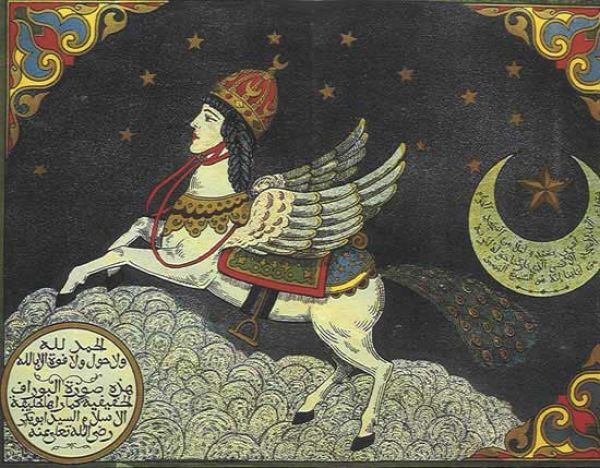
‘The Burāq and the Night Journey’.
A reproduction of a 17th century
Indian (Mughal) miniature.
Picture at Wikimedia Commons.
*
Today’s sharing from the Blue House of Via-HYGEIA is a short extract from Henry Corbin’s translation of Suhrawardi’s treatise, ‘Le Livre du Verbe du Sufisme’ (The Book of the Verb of Sufism, kitab Kalimat al-tasawwof )-It is Chapter XIV: ‘Que chaque Verbe en ce monde a un Iblīs‘, in its Fayard 1976 French edition. From page 167 to 169. A Via-HYGEIA English translation from the French.
This is priceless, as Professor Corbin published only a few excerpts from this treatise he translated from an un-published Arabic manuscript. We plan to publish soon the remaining translated chapters found in the Fayard edition, with some of his seminal commentaries.
**
Chapter XIV – That Every Verb
in this World has an Iblīs
There are thaumaturgical actions that you can witness among the ‘Brethren of spiritual retreat’ (Ikhwan al-tajrid), such as provoking or halting certain movements, bringing down a chastisement from heaven, causing rain to fall, etc. If you find it difficult to believe this, know nevertheless that bodies obey the Word of God (Kalimat Allah), even in the absence of any material contact. Indeed, you can observe that, even if it is cold, the body grows hot from the wrath of the soul. You have seen the influence of the imaginal (al-awhâm) upon a man, to the point that terror causes him to fall from the summit of a high, though narrow, wall. When the sagacity of the Verb is perfect, or if it receives the assistance of the sacrosanct world, it is not at all surprising that its power increases to such a degree that it is as if it were the Soul of the world.
The perception of knowledge, independently of any instruction regularly given by a human master, is not impossible. Simply observe the difference among individuals, your fellow men, in their faculty of penetration. The imbecile will never derive any profit from meditation, whereas the man of lively conception can imagine all sorts of hypotheses on a multitude of questions. Here there is no limit at which one must halt. Thus it is possible for a Verb (a soul) of powerful nature to perceive, in a very brief time, the realities of the world of the Intelligence, due to the perfection of its nature and its proximity to its Principle (the Intelligence, the Holy Spirit, from which it proceeds), as this verse says: ‘(The Angel), the Mighty, the Strong, taught it to him’ (Qur’an, 53:5-6).
The foreknowledge of things to come is not implausible, for the divine Verbs of the celestial Spheres (Kalimat Allah, Animae calestei) know the consequences inherent in their future movements and their past movements. Now, there is no other veil between our Verbs (our souls, Kalimáti-ná) and the Verbs of the celestial Spheres than the attachment (of our Verbs to our physical being). Sometimes the obstacles resulting from this attachment weaken, for example for some during sleep, for others in the course of illnesses that weaken the external senses, for others through spiritual exercises that liberate the internal senses and weaken the phantasis, for the latter is the perpetual disturber of the soul’s power. Then the soul, I mean the Verb, receives the imprint of sacrosanct realities. It rises in a nocturnal ascent to the world of the Imaginatio vera.
Often this world is mirrored in the sensorium. Then, in dream or in the waking state, the visionary Verb contemplates forms of utmost beauty, or hears a well-ordered discourse, of admirable coherence, or else the form of the world of Mystery manifests itself to him visually. But, if the weakening of the external senses is possible, their complete destruction is not. Hence a Quranic verse declares: ‘It is not given to any human that God should speak to him, except by inspiration or from behind a veil, or that He should send a Messenger’ (Qur’an, 42:51). For, as long as man remains in this world, the suggestions of the Satan never cease, though God the Most High has made him master over it.
The estimative faculty (wahm), that is IBLIS who refuses to bow before the khalif and Verb of God, when all the Angels who are the faculties of the soul, bow before this Verb (which is the soul). ‘Iblis refused and was arrogant, for he was among the unbelievers’ (Qur’an, 2:34). This is why all the immaterial realities that the intellect admits, this Iblis which is the estimative faculty, denies and rejects them. This Iblis is until the day of Resurrection “among those who are made to lag behind” (‘those who wait‘: monzarun)(Qur’an, 7:14). When man emerges from the tomb, the delay granted to him is blocked. And so our Prophet said: ‘There is none among you who does not have a demon (shaytán, the opponent)’.
(A Corbin Note: there is a tradition that says that ‘each prophet has his own Iblis‘, and the Prophet converted his to Islam. Iblis is the demon of agnosticism. He is the one who carries the soul into denying the realities of the spiritual world; he makes it stray within fantasy, and forbids her to to penetrate into the imaginal world because it would then allow the intellectual images to be projected into the sensorium, allowing the visionary event to happen, as the mystics report).
Just as the representative imagination receives the forms perceived by the sensorium, it happens that the Active Imagination takes hold of the sensorium. This occurs when the activity of the external senses, which kept the sensorium wholly occupied, relaxes, or when it prevented the soul from employing the Active Imagination in the service of its meditations and cogitations. Then forms and figures appear and shine in the sensorium. It is thus that jinn and other spiritual beings become visible. Even if the visionary were to close his eyes, he would continue to see them, with his eyes closed. For his vision proceeds from an interior cause.
*
Note upon Terms
used in this translation
Verbe / Verb: Retained with a capital ‘V’ when it translates Kalimah (Word of God, Logos) to distinguish it from ordinary speech. It signifies the divine, creative principle in man and the cosmos.
Âme / Soul: Often used interchangeably with ‘Verb‘ in this context, indicating the divine core of the human being.
Monde sacrosaint / Sacrosanct world: Refers to the transcendent, holy realm.
Monde de l’Intelligence / World of the Intelligence: The Mundus Intelligibilis, the realm of pure intellect and archetypal realities.
Imaginatio vera / True Imagination: A central Corbinian concept; not fantasy but an organ of perception for a visionary, spiritual reality.
Sensorium: The inner ‘space‘ or common sense where sensory data is processed and where spiritual forms can manifest.
Faculté estimative (wahm) / Estimative faculty: The faculty of practical, often instinctive or negative, judgment. Corbin explicitly identifies it with Iblis, the personal cosmic antagonist who refuses the sovereignty of the Spirit.
Phantasis: The lower, representational imagination, tied to sensory data and distinguished from the Imaginatio vera.
Formes / Forms: Refers not just to shapes, but to spiritual entities and archetypal figures perceived in the imaginal world.
*
Source

***

Related Articles


Leave a Reply