
Circle of Transmission: The Living Loom
A Cassette from Athos: On Receiving ‘Srpski Melodii od 14 do 18 Veka’ – An essay on a gift, a voice, and a tradition that outlasts the empires that carry it
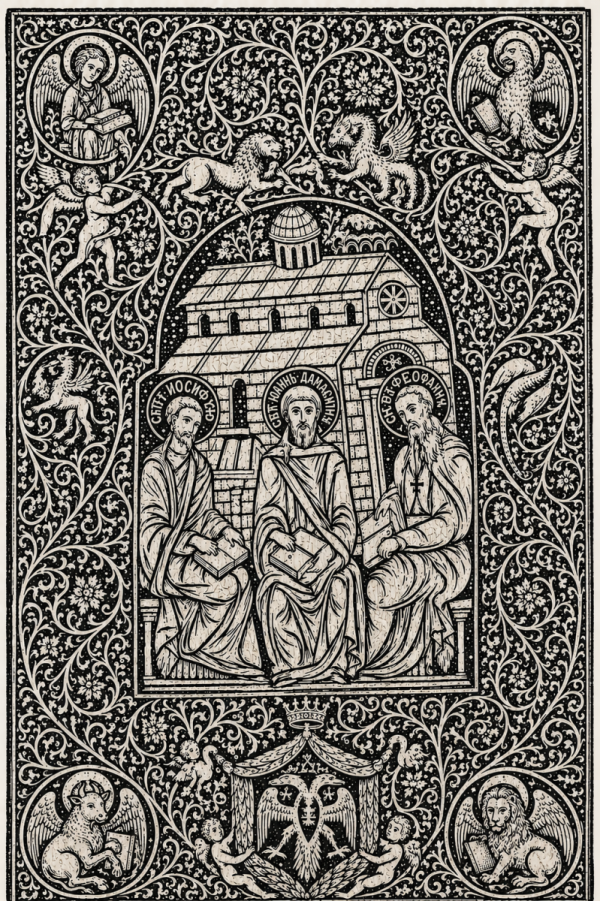
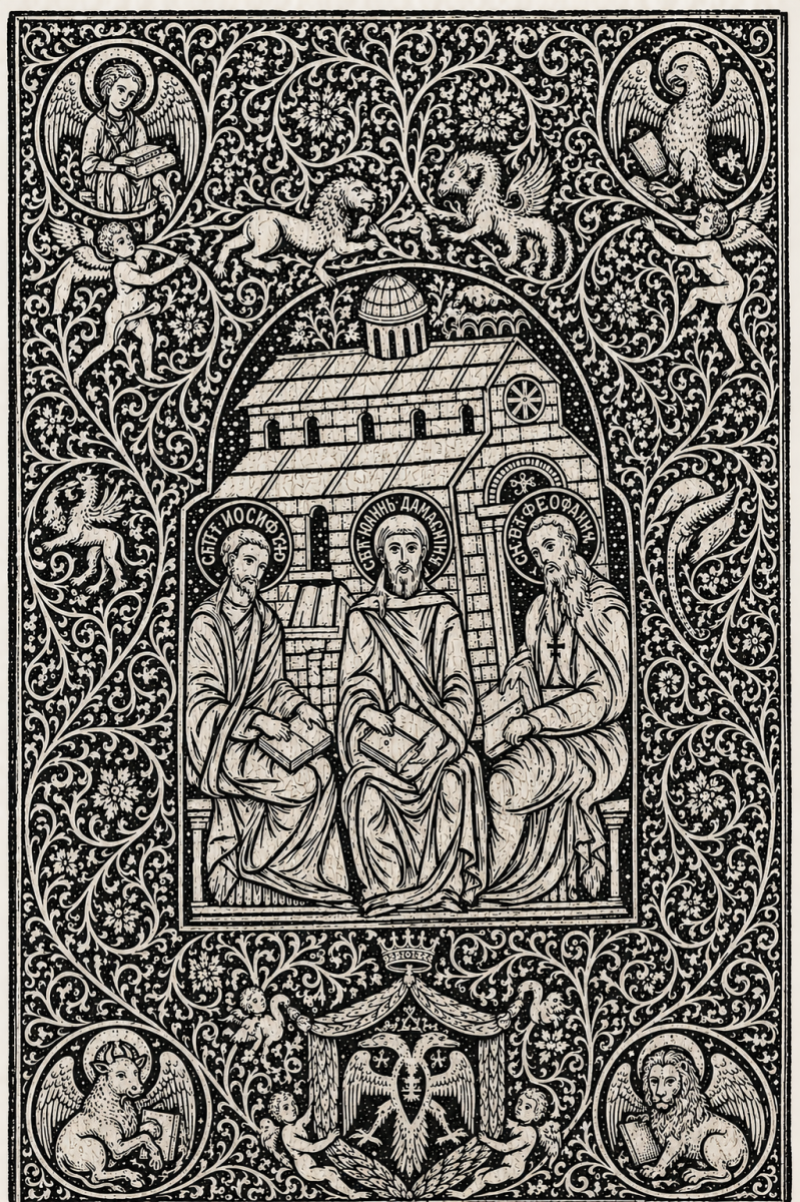
Notes on the Featured Illustration: The image presented here is a modern editorial reconstruction of the celebrated frontispiece from the Octoechos of the Fifth Tone (Oktoih Prvoglasnik), printed in 1494 at the Crnojević Press in Cetinje. It serves as the visual anchor for this reflection on the 1986 cassette of the same tradition.
The illustration presented here is a modern editorial reconstruction of the celebrated frontispiece from the Octoechos of the Fifth Tone (Oktoih Prvoglasnik), printed in 1494 at the Crnojević Press in Cetinje under the supervision of Hieromonk Makarije. As the first illustrated Serbian incunabulum, the Octoechos stands among the foundational monuments of South Slavic printing, marking the meeting of Byzantine liturgical tradition with the new technology of the movable press.
At the centre are the Three Great Hymnographers of the Orthodox Church—Saint Joseph the Hymnographer, Saint John of Damascus, and Saint Theophanes the Branded—seated before a church, each holding an open codex from which the sacred chants of the Octoechos proceed. Their solemn, hieratic figures embody the enduring Byzantine iconographic tradition, while the surrounding architectural setting evokes the sacred space in which those hymns were intended to resound.
Encircling the composition is a richly carved Renaissance border derived from Venetian ornamental models: scrolling acanthus, heraldic griffins, playful putti, the winged symbols of the Evangelists, and, at the base, the double-headed eagle of the Crnojević dynasty. This remarkable synthesis of Venetian decorative vocabulary with Serbian Orthodox spirituality reflects the unique artistic world of the Cetinje printing house, situated at the crossroads of East and West.
The present image is not a reinterpretation but an editorial facsimile reconstructed from a worn historical impression. Damaged or illegible passages have been restored with the aim of preserving the visual language of the original woodblock while retaining the slight irregularities characteristic of fifteenth-century relief printing. The result seeks to evoke the appearance of a freshly printed sheet as it may have emerged from Hieromonk Makarije’s press in Cetinje in the closing years of the fifteenth century.
*
Today’s sharing from the Blue House of Via-HYGEIA draws from our archives to present a gift that retains its emotional impact decades later.
In an earlier article, we shared our first encounter with the notion of sacrality distinct from dogma. We described discovering Marie-Joseph Canteloube’s Triptyque on a cassette tape—a mesmerizing interpretation by Frederica Von Stade that revealed a sacredness deeply connected to nature and a lost ‘Arcadian innocence‘.
The tape we present today marks a second, profound experience of such sacrality, this time rooted explicitly within a religious context, yet resonating with the same timeless power.
It is time to share more from these archives 🙂
**



1. A contextual Introduction
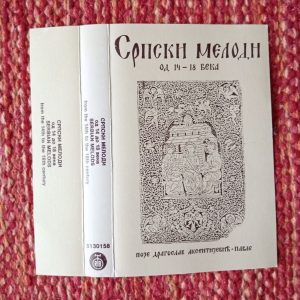
In the summer of 1986, somewhere in the echoing stone corridors of Hilandar Monastery on Mount Athos, a cantor named Dragoslav Aksentijević-Pavle stood before a microphone and sang into the silence of the Holy Mountain. The recording was released on a PGP-RTB cassette—catalogue number 5130158—manufactured by SOKOJ in socialist Yugoslavia, sold in state-run music shops, and carried home by pilgrims who had come to Athos not for icons or relics, but for something less tangible: the sound of time itself.
This cassette arrived as a gift from friends returning from the Mountain, and it has outlasted the political entity that produced it. Yugoslavia is gone. The cassette format is obsolete. But the music—monodic, unaccompanied, microtonal—remains immediate.
What follows is a walk through each melody, not as musicological documentation but as an act of remembrance: an attempt to honour the presential essence of a gift that continues to give.
2. The Voice: Dragoslav Pavle Aksentijević (b. 1942)
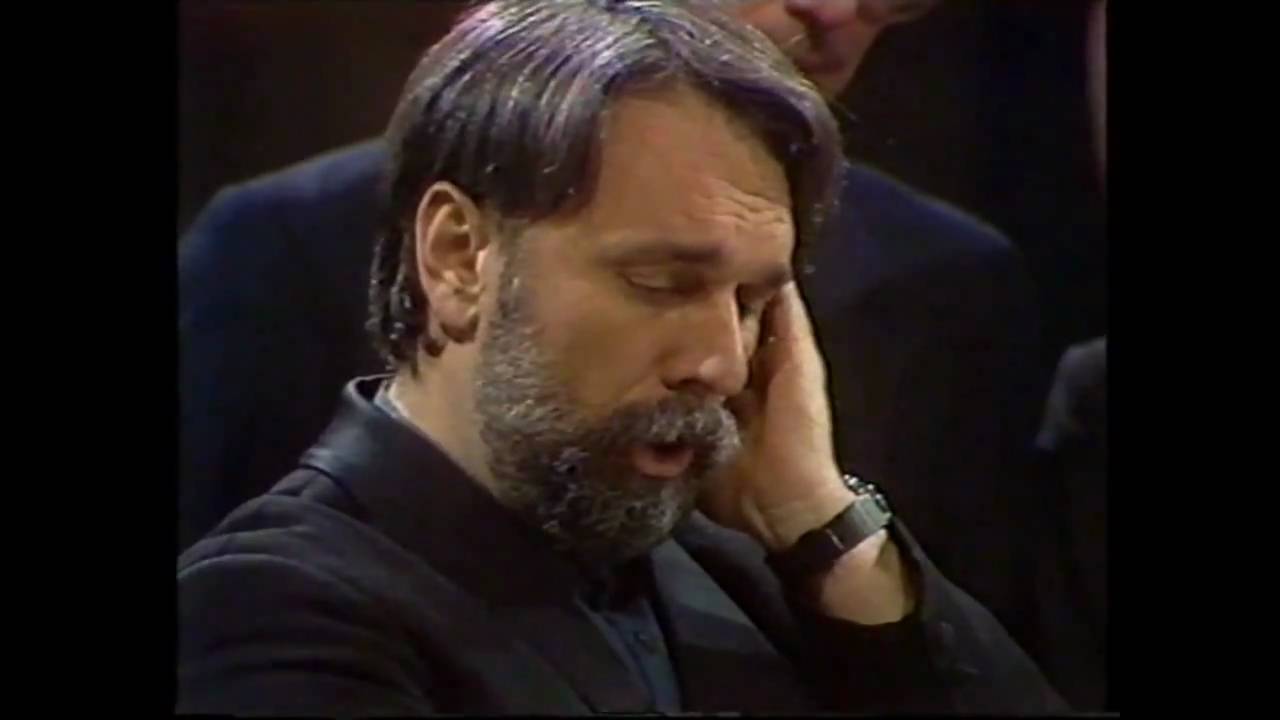
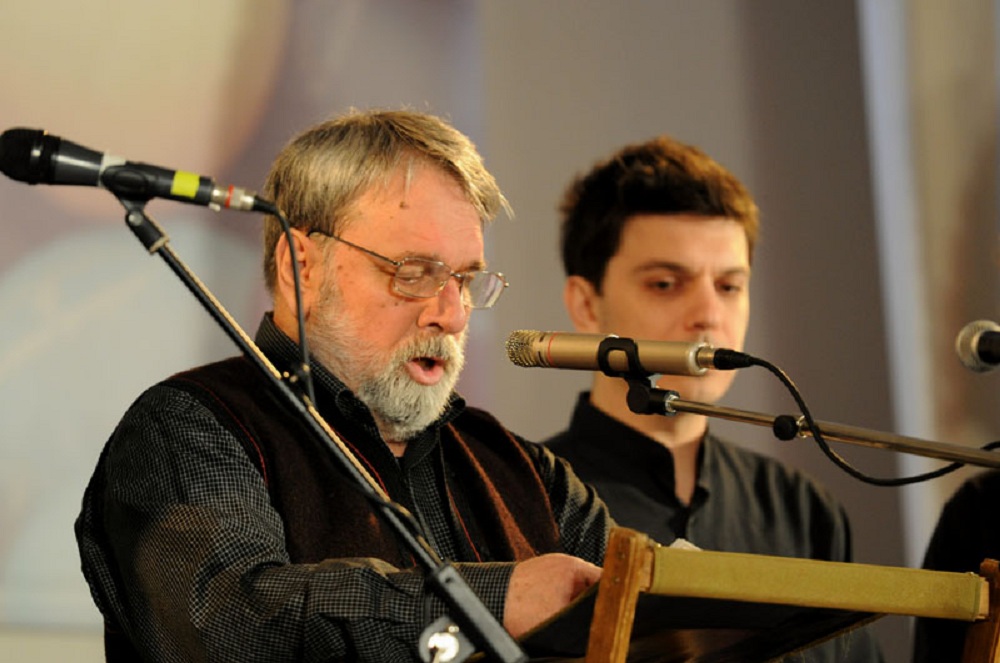
Dragoslav Pavle Aksentijević was born in Belgrade on 20 April 1942, in the middle of the war, in a city under occupation. He would later describe his path to the chant as neither planned nor trained but received—a vocation that arrived through the ear rather than the academy.
He was not, by formation, a musician. He was a painter. In 1967, he graduated with a Master’s degree from the Academy of Fine Arts in Belgrade, in the class of Milo Milunović, and his early career was devoted to icon and fresco painting in the Byzantine and Serbian medieval styles. The eye and the hand were trained before the voice. Yet the two arts were never separate for him: iconography and chant are, in the Orthodox understanding, two modes of the same logos—the word made visible and the word made audible.
Aksentijević’s icons and his singing share a quality: both are restrained, luminous, and saturated with a sense of time that is not historical but liturgical—time as it is experienced in the presence of the eternal.
His singing was self-taught. He never attended a conservatory of church music. Instead, he learned by listening—and by listening to the right sources. In a 2012 interview, he recounted a formative experience in the Machairas Monastery in Cyprus, where the abbot, Father Dionysius, gave him a cassette of his own chanting. “While the others were talking, I had headphones on. It was the most exemplary singing I have ever heard.” He sat with the cassette until it ran out; the abbot touched his shoulder gently and said, “It’s over.” Aksentijević replied, through a translator, that he had experienced something so sublime he would agree to end that moment with that chant.
He also studied directly on Mount Athos, where he was introduced to Father Dionysios Firfiris, the Protopsaltis—the First Cantor of the Holy Mountain. Three years after their first meeting, Firfiris recognised him from a distance and called out: “Pavlos!” Aksentijević was astonished. Father Chrysostom, who had introduced them, explained: “Ever since I told him that you are a Serbian priest, he has been praying for you every day.” The story is telling: on Athos, the singer is not a performer but a prayed-for—someone who enters into a relationship of spiritual accountability with the tradition he carries.
This is the voice that sings on the cassette. It is not a “performance” in the Western sense. Aksentijević has described the eight Byzantine echoi not as scales but as moral qualities: “The first is simple, serious; the second is penitent, prayerful, loving. The third is cheerful, encouraging, and the fourth has the qualities of all three previous ones. The fifth is most reminiscent of a lament. The sixth is the most passionate, the seventh is simple but difficult. Finally, the eighth is the crown of all the previous ones.” To sing in these modes is not to execute notes but to inhabit dispositions—to become, for the duration of the chant, a particular orientation of the soul toward God.
In 1987, the year after this cassette was released, he founded the Zapis Music Group (Zapis—”Inscription,” a word that carries the weight of sacred writing), an ensemble dedicated to the performance of Serbian and Balkan traditional music on authentic instruments. But the sacred music remained his core work—a parallel track of solo chanting that preserved the Byzantine and medieval repertoire in a period when it was threatened by the standardising “Karlovac chant” promoted by Stevan Mokranjac in the late 19th century. Mokranjac had stripped the chant of its ornaments, its microtones, its pathos; Aksentijević restored them, not as antiquarian curiosity but as living speech.
His discography for PGP-RTB includes this 1986 cassette, the 1987 LP Muzika Stare Srbije, and the 1990 LP Psalmi 13. i 14. vek—a body of work that constitutes one of the most important documentary recordings of the Serbo-Byzantine tradition. His awards include the First Prize for Interpretation of Byzantine Melodies at the International Choir Festival in Karditsa, Greece (1988), a Golden Medal from the Serbian Society for Culture and Education (1990), and the Annual Award from the Serbian Association of Music Artists (2000).
But the most telling testimony to his authority comes from Mother Agnija of the Vavedenje Monastery in Belgrade, who told him: “The Lord sings through you.” Aksentijević has repeated this more than once, not as boast but as burden—the recognition that the chant is not his but given, that the cantor is a vessel, not a source.
3. The Image:
The Cetinje Octoechos, 1494
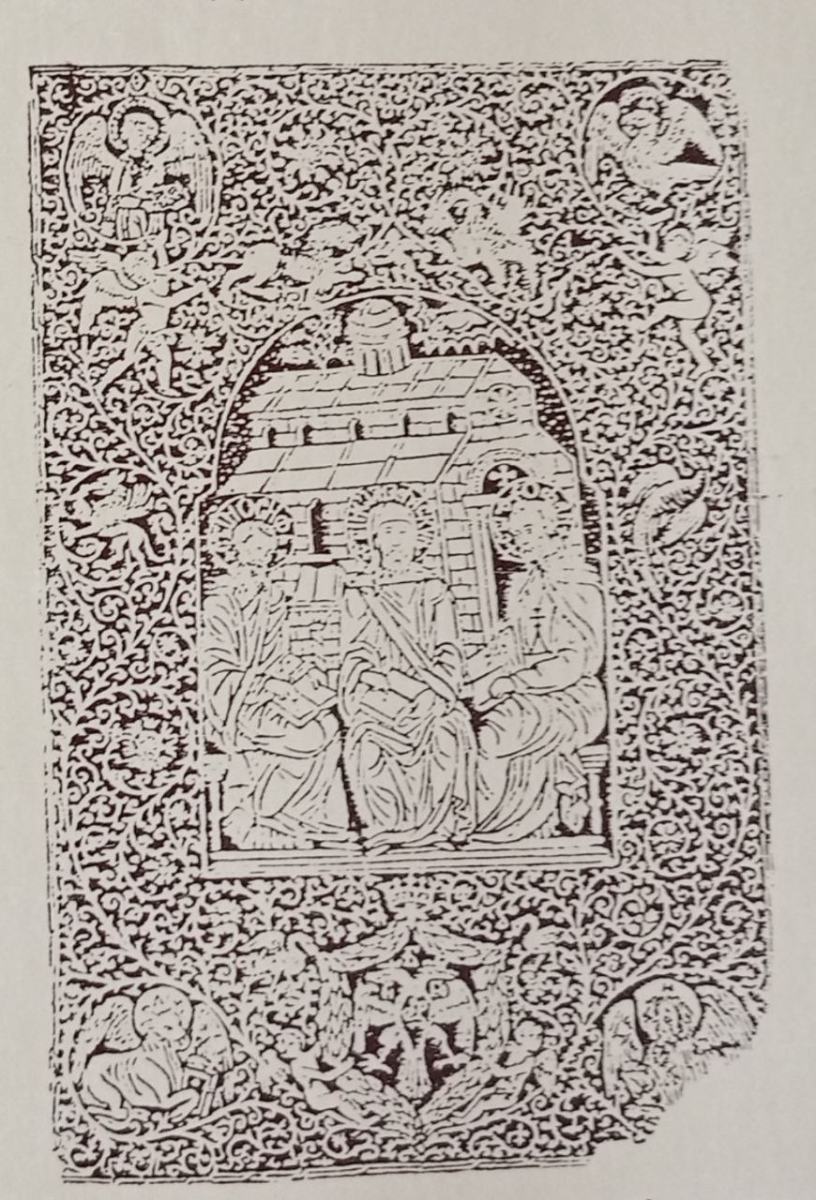
The cover of the cassette reproduces a woodcut from the Cetinje Octoechos of the Fifth Tone (Oktoih petoglasnik), printed in 1494 at the Crnojević printing house in Cetinje, Montenegro. The image shows the Three Hymnographers—Sts. Joseph the Hymnographer, John of Damascus, and Theophanes the Branded—seated on a bench before a church, each holding an open book.
The Crnojević printing house was established in 1493 by Đurađ Crnojević, ruler of the Principality of Zeta, with equipment imported from Venice. It was the first Cyrillic press in Southeast Europe. The technical editor was Hieromonk Makarije, a Serbian monk who had trained in Venice and who later, after the Ottoman conquest of Zeta in 1496, re-established printing in Wallachia and eventually became hegoumenos of Hilandar Monastery on Mount Athos—the same monastery whose bells open and close this cassette.
The woodcut was produced using separate blocks for the frame and the central scene. The frame features evangelist symbols, griffins, dragons, putti, and the Crnojević two-headed eagle; the central scene depicts the authors of the very texts that Aksentijević-Pavle sings. The style is a fusion of Byzantine iconography and Venetian Renaissance ornament—two worlds meeting at the Adriatic, as they would meet again five centuries later in a Belgrade recording studio.
The J-card explicitly notes: “Насловна страна: Српски мелодији из Цетињског октоиха, 1494” (“Cover: Serbian melodies from the Cetinje Octoechos, 1494”). The choice is deeply resonant. The Cetinje Octoechos is not merely the first Serbian printed book; it is the first materialisation of Serbian chant in print—the moment when the oral tradition of Byzantine melody was fixed in movable type, preserved for a community under Ottoman threat. The cassette, made in socialist Yugoslavia, carries on its cover the image of a book made in feudal Zeta, both of them preserving the same melodies across five centuries of political dissolution. The woodcut, carved in a press that existed for only three years, outlasted the empire that destroyed it.
The cassette, recorded in a country that would cease to exist within five years, now outlasts the state that produced it. Both are fragile vessels—wood and paper, magnetic oxide and plastic—carrying something that refuses to be contained by material form.
IV. The Music:
A Walk Through the Melodies
Side 1: The Mountain Speaks
1. Хиландарска звона / Bells of Chilandar: The programme opens not with a human voice but with bronze. The bells of Hilandar—the Serbian monastery founded in 1198 by Stefan Nemanja, the grand prince who abdicated his throne to become the monk Simeon—are the acoustic signature of Athos. They do not mark time so much as inhabit it. In the Byzantine tradition, bells are not merely signals; they are voices, participating in the unceasing prayer of the Mountain. The peals here are irregular, conversational, almost hesitant—as if the bells themselves are listening before they speak. This is the sound of a place where time is measured not in hours but in horologion—the Book of Hours. The bells do not summon; they announce that summoning is already underway, has always been underway, will never cease.
2. Исаија Србин — Ходите сви земнородни / Isaiah the Serb — Come All Ye Sons of Earth (15th c.): And then a voice emerges from the bell-silence. Isaiah the Serb—as if nationality were a liturgical title—was a composer of the mid-15th century, active in the twilight of Byzantine Constantinople. His Come All Ye Sons of Earth is an acolouthia, a festal service, and its text is a summons: Pridete vsi zemlnorodnyi—”Come, all ye born of earth.” But the summons is not urgent; it is patient, iterative, almost hypnotic in its repetition. Isaiah wrote in both Church Slavonic and Greek, moving between languages as if they were two registers of the same mystery. The melody unfolds in the first plagal mode, with the characteristic Byzantine petaste—a quick upward leap followed by a gentle descent—that gives the chant its floating quality. What is being summoned is not merely an audience but a communion: the earth itself is invited to become liturgical space.
3. Кир Стефан Србин — Окусите и видите / Kir Stefan the Serb — Taste and See (15th c.): Kir Stefan—kyr, “lord,” a title of respect for a senior cantor—composed this setting of Psalm 33:9 for the Psaltikija, the Serbian chant book that was destroyed in the German bombing of Belgrade in 1941. Only twelve photocopied pages survived. This recording, then, is a kind of resurrection: a voice singing from a burnt book. The text is the Communion verse: Vkusite i vidite, yako blag Gospod—”Taste and see that the Lord is good.” The melody is restrained, almost austere, as if the composer understood that the moment of tasting is not one of exuberance but of recognition. The Lord is good; the proof is in the tasting, not the description. Kir Stefan’s setting moves in narrow intervals, a syllabic declamation that lets the words do their own work. It is music as witness, not commentary.
4. Кир Стефан Србин — Сада силе / Kir Stefan the Serb — Now the Celestial Powers (15th c.): The Cherubic Hymn—Nynya sile nebesnye—is the theological centre of the Byzantine Liturgy, sung during the Great Entrance as the bread and wine are carried to the altar. The text invokes the angelic powers who minister “invisibly with us,” collapsing the distance between heaven and the nave. Kir Stefan’s setting is more elaborate than his Taste and See: the melisma on nebesnye (“celestial”) extends the word into a region of pure sound, as if the voice itself were attempting to become invisible. The manuscript signature—Tvorenie domestika kir Stefana Srblina—identifies the composer as a domestikos, the leader of the monastic choir. This is music written by a man who knew the acoustics of stone, who understood that in a Byzantine church the voice does not project but resonates, finding its true form in the echo rather than the attack.
5. Сервикон (16. век) / Servikon (16th century): Here words dissolve. The Servikon is a kalophonic elaboration of the asmatikon—the “sung” syllables that serve as the intonation formulas for the eight Byzantine modes. What emerges is not speech but voice: ananes, neanes, nana, hagia, aneanes—syllables that have no lexical meaning but carry modal identity. The 16th-century composer (anonymous, as is fitting) treats these formulas as raw material for virtuosic display, extending a single syllable across dozens of notes, weaving the voice into arabesques that seem to suspend time. This is the kalopoiia—”beautiful-making”—of the late Byzantine tradition, music that exists for its own sake within the liturgy, a moment of pure aesthetic contemplation that needs no theological justification because it is theological: the unspeakable made audible.
6. Господе зовем (18. век) / Lord I Have Cried (18th century) Gospode, vozzvakh k Tebe: the opening of Vespers, Psalm 139:1. By the 18th century, the Serbian chant tradition had absorbed the post-Byzantine melos of the Ottoman period: more ornament, more rhythmic flexibility, a certain melancholy that was not present in the austere 15th-century settings. The text is a cry—vozzvakh, “I have cried out”—but the melody does not cry. It confesses, in the old sense of the word: it speaks with (con-) faith (fessio), aligning the voice with the Psalmist’s supplication. The 18th-century setting likely derives from the Karlovci or Belgrade chant schools, where Serbian cantors preserved Byzantine structures while allowing local inflection—the ison drone slightly sharpened, the melos more florid. It is the sound of a tradition that has survived empire and is learning to sing again.
7. Презревши нижње као безвредно (18. век) / Despising the Lower as Worthless (18th century): Prezrevshi nizhnye yako bezvredno—”Despising the lower things as worthless.” This sticheron from the Octoechos is an ascetic text, but the melody does not punish. It mourns, gently, the necessity of leaving behind “motherly love” and earthly attachment to follow the Crucified. The text addresses Christ on the Cross, noting that He had “neither mother nor servant” beneath Him—a stark image that the melody does not dramatise but rather intones, letting the words carry their own weight. The 18th-century composer understood that the most devastating truths are best spoken quietly. The melody moves in the fourth mode, with its characteristic plagal descent, a falling that feels like surrender rather than defeat.
Side 2: The Mountain Answers
1. Исаија Србин — Српски полијелеј / Isaiah the Serb — Serbian Polyeleos (15th c.): The Polyeleos—”Many Mercies”—is the festal heart of Matins, sung on Sundays and great feasts. Isaiah’s setting of Psalms 134–135 is his masterpiece, existing in two versions: one with Church Slavonic text, one with Greek. The text is an invitation to praise: Khvalite imya Gospodnya—”Praise the name of the Lord.” But the melody is not merely celebratory. It is architectural, building structures of sound that mirror the stone churches for which it was written. The Polyeleos is sung by the full choir, but here Aksentijević-Pavle sings alone, and the effect is not diminished but concentrated: one voice carrying the memory of many. The Alleluia refrains—Alliluiya, alliluiya—become incantatory, losing their semantic content and becoming pure phonemes of praise. This is Isaiah at his most expansive, and the Serbian tradition at its most confident: a composer who could stand with his Greek contemporaries and sing in his own voice.
2. Јоаким Харсианитски — Кратима теримем / Joachim of Charsianitis — Kratima Terirem (14th c.): Joachim of Charsianitis—Joachim the Charsianite—was a 14th-century Byzantine maistor who composed kratēmata, the “prolongations” sung on nonsense syllables during silent liturgical actions. Terirem is the most famous: a vocalise on terirem, tiriri, tototo, nenena that lasts for many minutes, the voice weaving patterns that have no referent outside themselves. In the Byzantine understanding, these moments of wordless song are not empty but full—they represent the apophatic dimension of theology, the recognition that God exceeds all language. The kratēmata are the sonic equivalent of the Cloud of Unknowing: the singer enters a region where meaning is not absent but transcended. Aksentijević-Pavle’s performance is remarkable for its breath control and its patience—he does not rush the ornaments but lets each terirem unfold in its own time, as if the syllables themselves were discovering their form moment by moment.
3. Хиландарска звона / Bells of Chilandar: The bells return, closing the programme as they opened it. But they are not the same bells. The first Bells of Chilandar announced entry; this second sounding announces departure—or rather, the impossibility of departure, since the bells continue to ring in the listener’s memory long after the cassette ends. The programme is a circle: bronze, voice, voice, voice, voice, voice, voice, bronze. The human melodies are framed by the non-human, as if to remind us that the chant tradition does not belong to the cantors but to the Mountain itself. The bells have been ringing since 1198. They will ring after the last cassette player has ceased to function. They are the ison beneath the ison, the drone that needs no voice.
5. Conclusion
This cassette is a time capsule from a country that no longer exists, recording a tradition that refuses to die, given as a gift by friends who walked the same paths that Stefan Nemanja walked when he left his kingdom for the Mountain.
The presential essence of the gift is not in the plastic shell or the magnetic tape but in the act of carrying: the friends who bore this music down from Athos, who chose to bring back not an icon or a prayer rope but a voice, understood that the Holy Mountain is not a place but a frequency, and that the only way to share it is to let it sound.
The music is still sounding. The bells are still ringing. The cassette may be obsolete, but the melody is not. It is waiting, as it has always waited, for the next voice to take it up and carry it forward.
Sources and Acknowledgements
The cassette Srpski Melodii od 14 do 18 Veka (PGP-RTB 5130158, SOKOJ, 1986) was performed by Dragoslav Aksentijević-Pavle, with sound engineering by Slobodan Mladenović, production and design by Dragoslav Aksentijević, and editorial supervision by Stanko Terzić.
The cover reproduces the woodcut of the Three Hymnographers from the Cetinje Octoechos of the Fifth Tone (1494), printed at the Crnojević press under Hieromonk Makarije.
Biographical information on Aksentijević-Pavle derives from interviews and discographic records; historical information on the Cetinje Octoechos from the work of Pavle Ivić, Ljubomir Maksimović, and Vladimir Simić. The liturgical texts are standard Octoechos and Psaltikon readings, rendered here from Church Slavonic into English.
*
And a video of a concert in which these hymns
were sung by Dragoslav Pavle Aksentijević
***


Leave a Reply